
Eyepieces
Eyepieces are where the telescope meets the observer. The right eyepiece can transform a good view into an unforgettable one — especially when you’re sharing the sky with the public through large Dobsonian telescopes.
Our Philosophy
As Ed Ting famously said, “There is TeleVue… and everyone else.” We tend to agree.
The majority of our observing — and nearly all outreach events — are done using TeleVue eyepieces, primarily from the Nagler and Ethos lines. Their extremely wide fields of view pair perfectly with our large Dobsonian telescopes.
Because most of our big Dobs do not have tracking, objects naturally drift through the field of view. Wider eyepieces keep targets visible longer, making it easier for guests to observe without constant telescope adjustments — while also delivering breathtaking immersive views.
Many outreach groups opt for less expensive eyepieces in case of accidental damage. We understand that approach — but we believe the views we share are worth the risk.
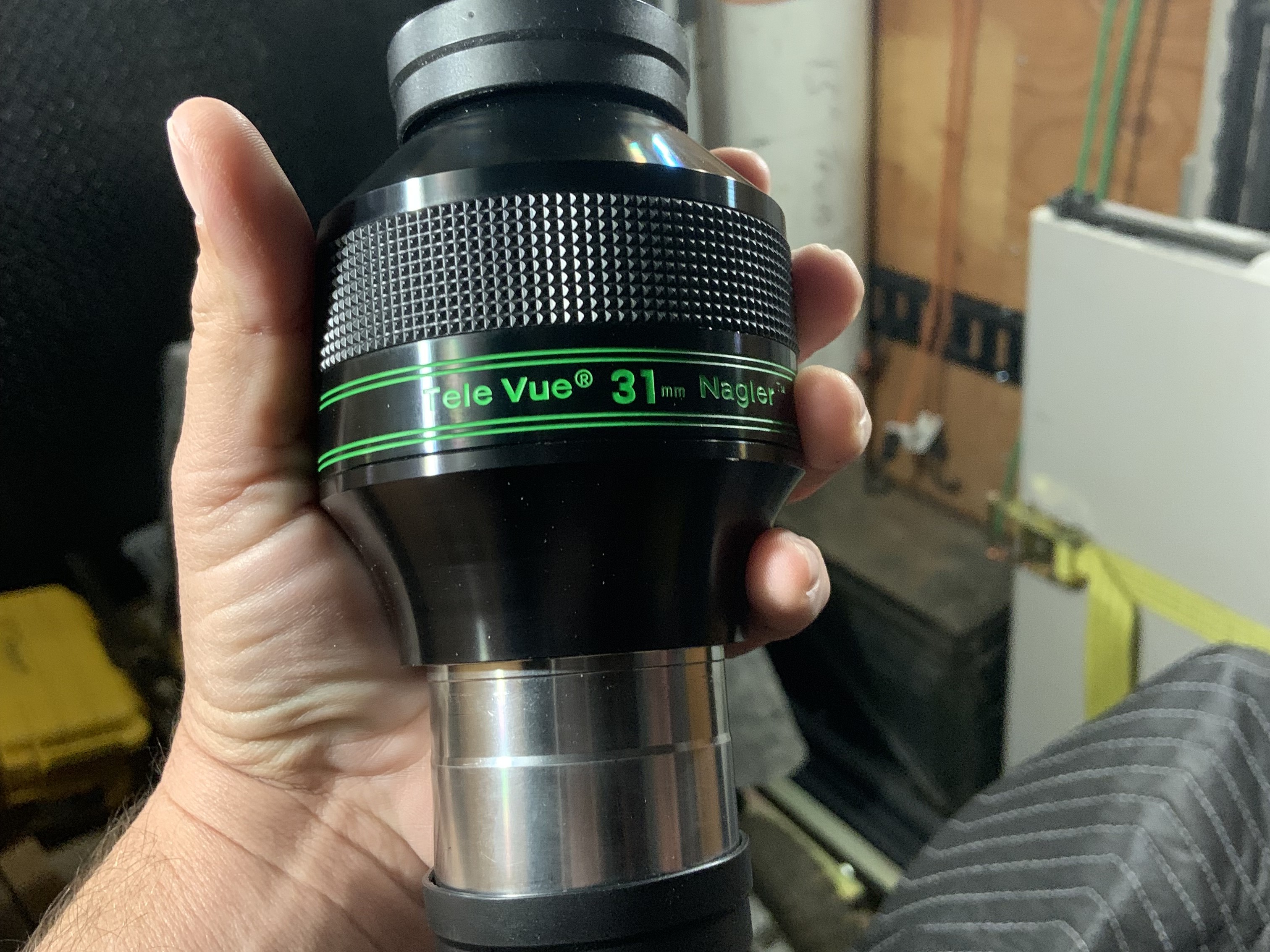
Holding a “Hand Grenade”
James holding a TeleVue 31mm Nagler Type 5 eyepiece—often nicknamed the “hand grenade” or “pineapple” due to its large size and weight—commonly used for low-power, wide-field views in large Dobsonian telescopes during outreach events.
The Three Eyepieces You Really Need
While we own far more eyepieces than we probably should, our opinion is that most observers only need three core focal lengths to cover nearly all observing situations:
-
Low Power
Used for spotting objects, scanning the sky, and viewing large deep-sky targets like nebulae and galaxies.
Our typical choice: TeleVue 31mm Type 5 Nagler -
Medium Power
The most versatile range — excellent for galaxies, globular clusters, and detailed lunar observing.
Our typical choices: TeleVue 21mm or 17mm Ethos -
High Power
Ideal for planetary observing, lunar detail, and tight double stars.
Our typical choices: TeleVue 13mm or 10mm Ethos
Of course, we don’t always follow our own advice. Large outreach events can involve six or more telescopes running simultaneously — which is our perfectly reasonable excuse for owning far more eyepieces than necessary.
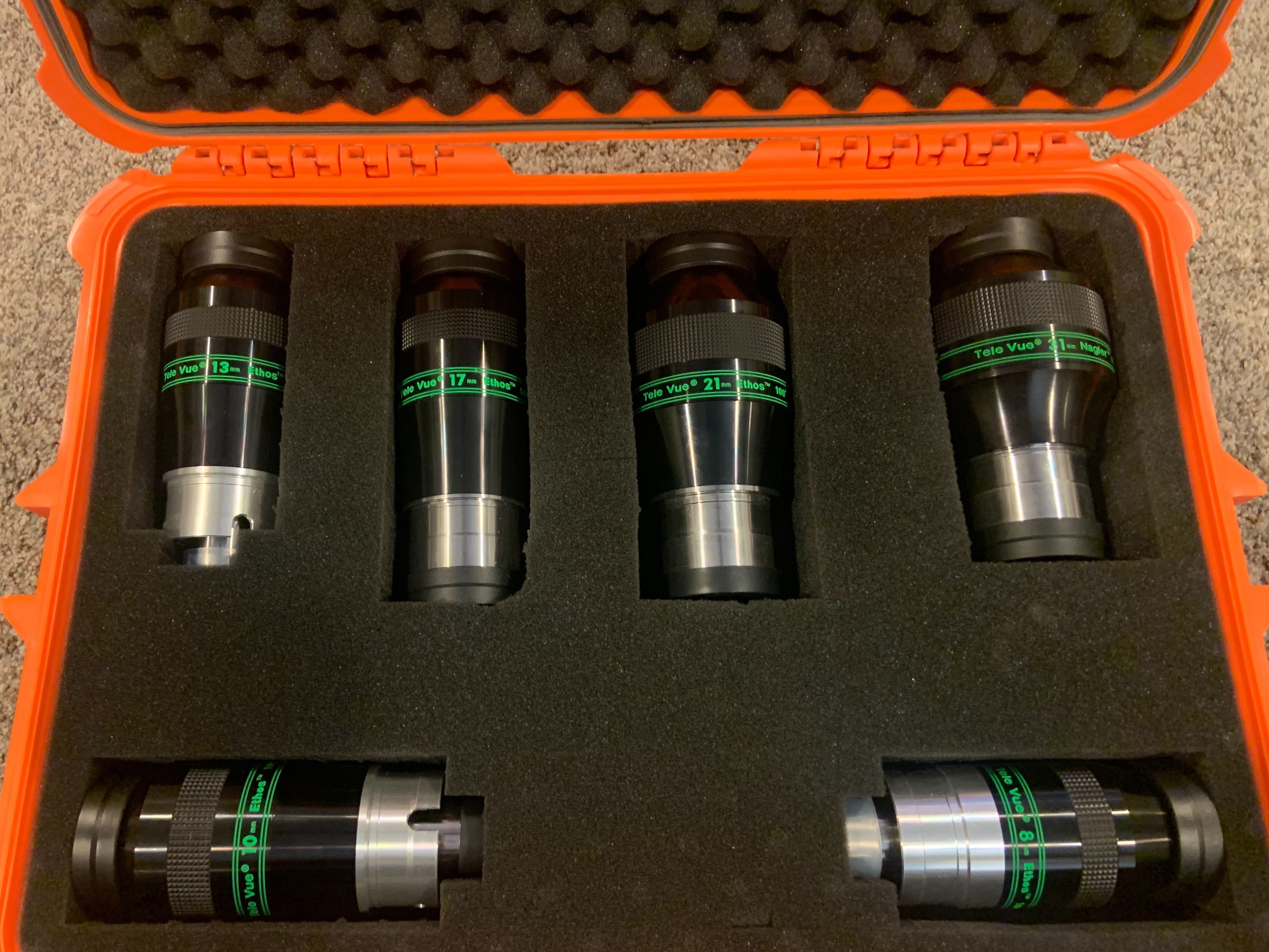
TeleVue Eyepiece Collection
An Apache hard case housing our primary TeleVue eyepiece lineup used for outreach and deep-sky observing. Featured are the 31mm Nagler Type 5 alongside the 21mm, 17mm, 13mm, 10mm, and 8mm Ethos eyepieces. This set covers our full observing range from low-power wide-field scanning to high-power planetary and lunar viewing, all protected and organized for transport to events and dark-sky sites.
Key Eyepiece Specifications
Apparent Field of View (AFOV)
Apparent field of view describes how wide the view appears when looking through the eyepiece. Wider AFOV eyepieces (like Nagler and Ethos) create an immersive “spacewalk” effect and keep objects visible longer in non-tracking telescopes.
True Field of View (TFOV)
True field of view is how much sky you actually see. It depends on both the eyepiece AFOV and the telescope’s focal length.
Eye Relief
Eye relief is the distance your eye can be from the lens while still seeing the full field. Longer eye relief is more comfortable and essential for observers who wear glasses.
Focal Length
Eyepiece focal length determines magnification. Longer focal lengths produce lower magnification, while shorter focal lengths increase power.
Exit Pupil
Exit pupil is the diameter of the light beam leaving the eyepiece. It affects brightness and viewing comfort. Larger exit pupils are brighter but can wash out contrast under light-polluted skies.
Magnification & Calculations
Magnification is calculated using a simple formula:
Example:
- 2,000mm telescope ÷ 31mm eyepiece ≈ 65×
- 2,000mm telescope ÷ 13mm eyepiece ≈ 154×
In large Dobsonian telescopes, we typically operate within magnification ranges of:
- Low Power: 50× – 100×
- Medium Power: 100× – 200×
- High Power: 200× – 400×+
Atmospheric conditions (“seeing”) often limit how much magnification is actually usable on any given night.