
The Moon
The Moon is often the first object people observe through a telescope and for good reason. Its ever-changing phases, dramatic shadows, and easily visible surface features make it one of the most rewarding objects in the night sky.
Explore the Moon
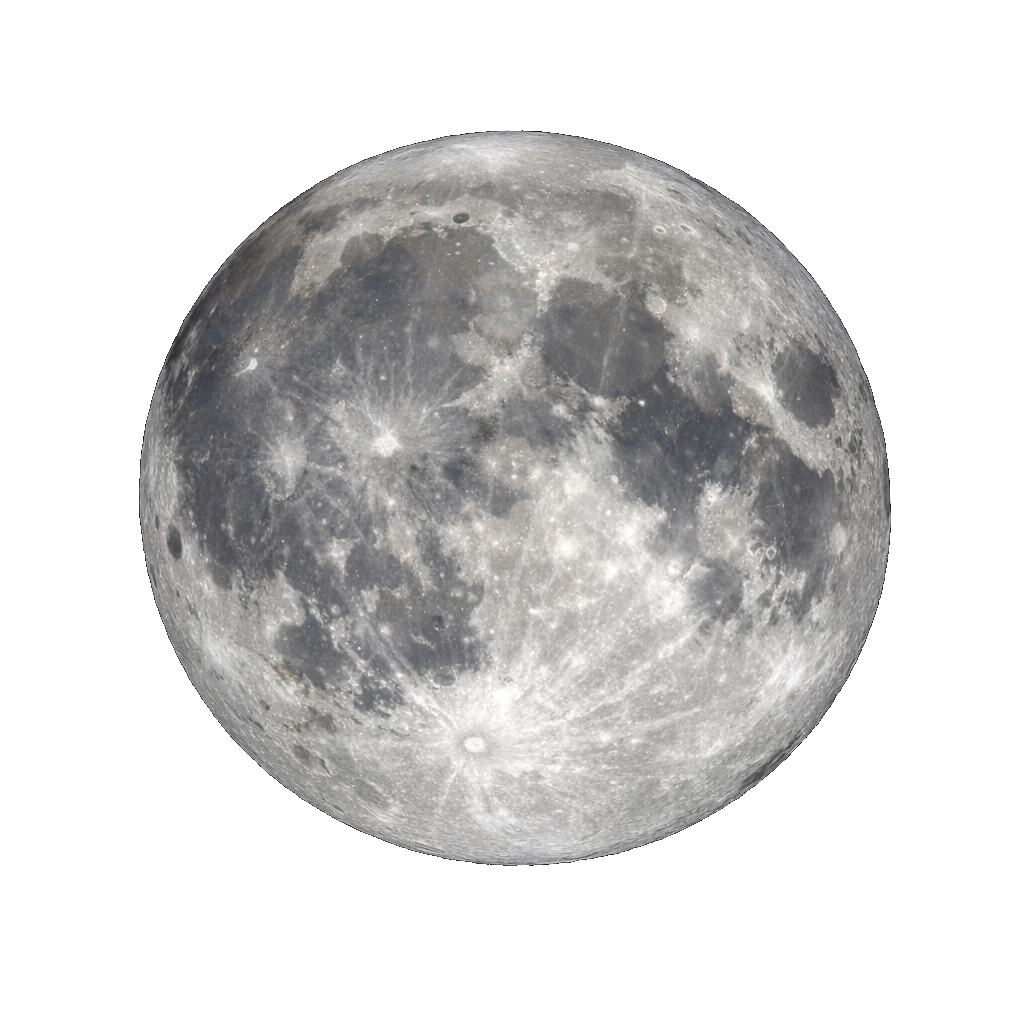
These features may look small, but they are enormous comparable to cities and states on Earth.
Observing the Moon
You don’t need expensive equipment to enjoy the Moon. Even a simple pair of binoculars reveals craters and dark plains, while a telescope brings out incredible detail. The key to great lunar observing isn’t magnification - it’s timing.
Moon Phases
The Moon doesn’t produce its own light it reflects sunlight. As it orbits Earth, we see different portions of its illuminated surface, creating the phases of the Moon. Check out the upcoming Moon phases on our Calendar.
Quarter Moon – The Best Time to Observe
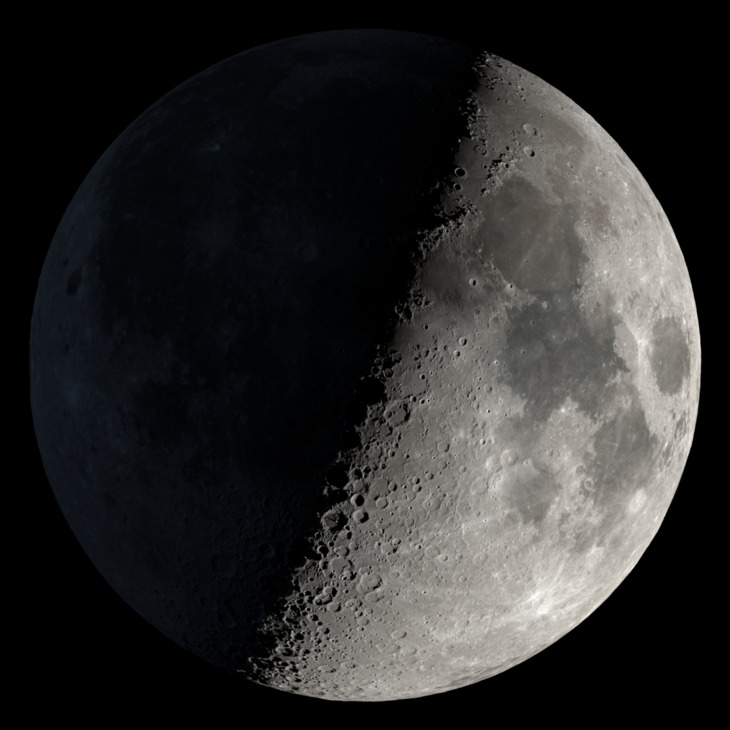
A quarter moon (first or last) is the ideal time for lunar observation. The terminator the line dividing light and dark creates high-contrast, 3D shadows across the surface.
First Quarter Moon
At First Quarter, half of the Moon’s visible surface is illuminated. The low-angle sunlight along the terminator creates strong shadows, making craters and surface features stand out with exceptional clarity.
- The Terminator: Where shadows are longest and detail is best.
- Ptolemaeus, Alphonsus, and Arzachel: A striking chain of large craters.
- Clavius: A massive crater basin ~140 miles across.
- Straight Wall (Rupes Recta): A dramatic 68-mile fault line.
- Mare Serenitatis & Mare Tranquillitatis: Dark lava plains.
- Mountain Peaks: Bright points of light just past the terminator.
Full Moon – What to Look For
During a full moon, sunlight hits the surface directly, reducing shadows and washing out fine detail. However, this is the best time to observe bright, high-contrast features.
- Ray Systems: Bright streaks from impacts (Tycho, Copernicus).
- Lunar Maria: Vast dark plains like Mare Imbrium.
- Bright Craters: Tycho and Copernicus stand out clearly.
- Mountain Ranges: Montes Apenninus along Mare Imbrium.
- Libration: The Moon “wobbles,” letting us see slightly more than half.
Want to see the Moon like this in person? Join us at one of our outreach events.
What Can You See with a Large Telescope?
With a large telescope like a 25-inch Obsession, the Moon becomes incredibly detailed. You can clearly see crater walls, central peaks, mountain ranges, rilles, and subtle surface textures but not man-made objects like the Apollo landing sites.
Under real observing conditions, a telescope of this size can resolve details on the Moon about 1 to 2 miles across. That’s roughly the size of a small town.
In perfect conditions, the theoretical limit is even smaller. A 25-inch telescope has a resolution of about 0.22 arcseconds, which corresponds to roughly 0.25 miles (400 meters) at the Moon’s average distance.
However, Earth’s atmosphere almost always limits what we actually see. Turbulence in the air blurs fine detail, so real-world resolution is typically closer to that 1–2 mile range.
It’s important to understand that “resolution” doesn’t mean seeing something as a single dot it means being able to distinguish two separate features. Anything smaller than that blends together. That’s why we can see detailed crater structures, but not small objects like spacecraft or flags.
To put this into perspective, very large features dominate the view. Something the size of the Salton Sea would appear enormous on the Moon, spanning a significant portion of the telescope’s field.
Effects on Earth
The Moon’s gravity plays a major role in shaping life on Earth. Its gravitational pull drives ocean tides and helps stabilize Earth’s axial tilt, contributing to a more stable climate over time.
The Moon is tidally locked to Earth, meaning it rotates on its axis at the same rate it orbits our planet. As a result, we always see the same side of the Moon. This effect is caused by gravitational interactions over millions of years, which gradually slowed the Moon’s rotation until it became synchronized with its orbit. Earth is also experiencing tidal forces from the Moon, which are slowly lengthening our days and pushing the Moon farther away. Over an extremely long timescale, Earth could eventually become tidally locked to the Moon as well, but this would take billions of years and is unlikely to fully occur before the Sun evolves into a red giant.
Libration
Libration is the slight “wobble” of the Moon that allows us to see about 59% of its surface over time instead of just 50%. Although the Moon is tidally locked and always shows nearly the same face to Earth, its orbit and rotation are not perfectly uniform. Small variations in its speed and the angle we view it from cause it to appear to rock gently back and forth. This motion reveals a little more around the edges letting us peek slightly “around the corners” of the Moon over the course of a month.
Common Questions
Can I see the flag on the Moon?
No - even with extremely large telescopes, the Apollo flags are far too
small to resolve from Earth. You would need a telescope roughly the size
of Earth to see them directly.
Did we really land on the Moon?
Yes. Multiple independent lines of evidence confirm the Apollo missions:
- Other countries tracked the missions in real time
- Modern spacecraft have photographed the landing sites
- Laser reflectors left on the Moon can still be used from Earth
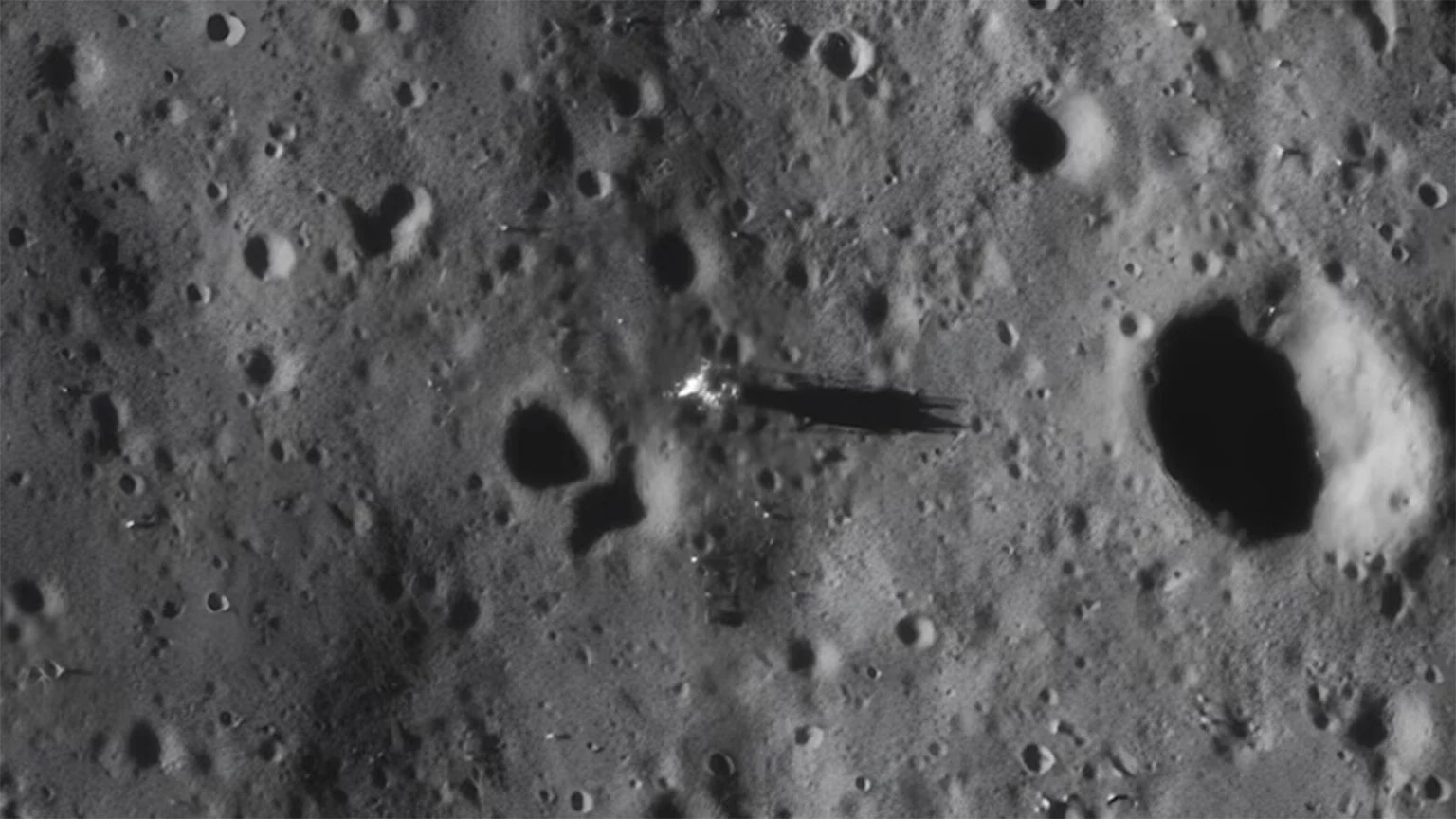
Apollo 11 Landing Site
This image shows the Apollo 11 landing site as seen by India’s Chandrayaan-2 spacecraft. The descent stage of the Lunar Module remains on the surface, exactly where astronauts left it in 1969. Modern missions from multiple countries have independently imaged these sites, providing clear and ongoing confirmation of the Apollo landings.
Artemis Missions
NASA’s Artemis program is returning humans to the Moon for the first time in over 50 years. These missions aim to establish a sustainable presence and prepare for future exploration of Mars.
Can you see Artemis spacecraft with a telescope?
In theory, yes - but in practice, it’s extremely difficult. Spacecraft like NASA’s Artemis II Orion capsule can become bright enough to detect
with a telescope, but they move quickly and don’t have easily accessible real-time tracking data. Even with a large telescope, they would only
appear as a faint, fast-moving point of light and are not practical targets for visual observing.
Fun Fact: In Greek mythology, Artemis is the twin sister of Apollo. It’s a fitting name, the Apollo missions first brought humans to the Moon, and now Artemis is leading the way back.
We are currently entering a new era of lunar exploration with the Artemis program. Learn more at www.nasa.gov/humans-in-space/artemis/
Observe the Moon Day
International Observe the Moon Night is a global event that encourages people to look up, learn about the Moon, and share the experience with others.
We support High Desert Astronomical Society every year at this event and hope to see you there. Keep an eye on our Calendar for more information.